
Working with heritage buildings presents a unique set of challenges. From missing documentation to warped, non-standard structures, successful restoration requires a blend of careful preparation and expert application.
We recently supported a significant upgrade of a heritage-listed commercial and educational building in Brisbane.
Our role was to strengthen, modernise, and secure the structure while protecting its heritage character. In partnership with our sister company, Studio Steel, Evolution Digital Construction delivered a series of structural and architectural upgrades, including:
- Chimney and ring-beam strengthening
- Veranda restoration
- New stair and fire egress structures
- Architectural steelwork
- Installation of security screens, perforated mesh, and mechanical enclosures
Navigating a Complex Heritage Site
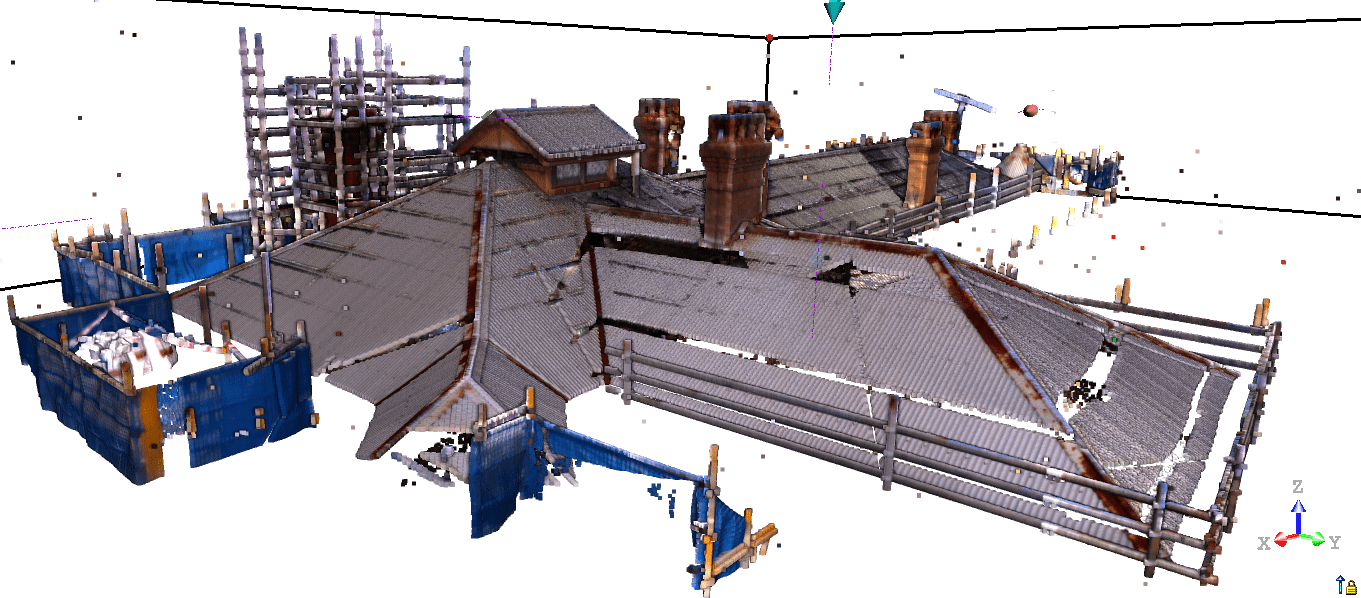
To ensure accuracy, we began with detailed reality-capture surveys using LiDAR technology. These scans enabled us to create and analyse 3D models, informing every stage of design and construction.
Evolution Digital Construction produced detailed 3D shop models, verified through their integrated workflows. These models enabled Studio Steel to fabricate with confidence, supported by model-based production management and traceability systems, capabilities made possible through Evolution Digital Construction’s tailored processes. Studio Steel then continued with the installation of all structural steel, stairs, mesh screens, and handrails with clarity. Throughout construction, a robotic total station and progressive scanning ensured millimetre-perfect precision.
The result was complete digital-to-installation certainty within a complex heritage environment.


The Challenge
As Evolution Digital Construction’s Clint Stevens explains, historic buildings often come with little to no documentation.
“We were dealing with a non-square, non-plumb, historically warped building, where traditional measure-and-install methods would have led to fit issues, rework, delays, and potential heritage damage.
“3D modelling allowed us to work within extremely tight tolerances and sequence the build correctly. Our continuous 3D scan-to-BIM integration used real-world geometry to inform design and fabrication, with live digital feedback loops to the client and site teams.”
Through digital clash identification, virtual constructability planning, and real-time coordination, the Evolution Digital Construction team transformed an unpredictable, high-risk environment into a digitally predictable, error-free delivery.
A Modern Outcome that Respects the Past
With the building’s stair system and screens installed seamlessly on the first attempt, our process achieved zero site rework and zero steel re-fabrication.
The finished building is now structurally improved, safer for public use, and equipped with an upgraded egress route.
For the client, this precision translated into reduced installation time, cost, and disruption, as well as a modernised building that retains its heritage charm.